

.png)
Clear guidance, honest answers, and practical steps to help you prepare, even while the details are still evolving.
What We Know To Date
The EU Pay Transparency Directive (Directive 2023/970/EU) is new legislation designed to make pay decisions more transparent, consistent, and easier for employers to justify. It was adopted in May 2023, with member states, including Ireland, given until 7 June 2026 to incorporate it into national law.
Its purpose is to close the gender pay gap and ensure people doing the same work or work of equal value are paid fairly. To achieve this, the Directive increases openness around how pay is set and gives employees clearer access to information.
As it stands, in Ireland (and across Europe), it’s unlikely that national legislation will be fully implemented by the June deadline. But even if timelines shift, the requirement does not.
Employers are expected to comply as soon as the law takes effect. This means the evidence employers will need to defend pay decisions in 2026 must already exist in performance cycles from 2025 or earlier.
The Directive came about because the EU wants to tackle the root causes of unfair pay differences:
- Unexplained pay gaps that persist even when employees do the same work or work of equal value.
- Inconsistent or undocumented pay decisions which make it hard for employees to understand or challenge pay decisions.
- Limited access to information that mean employees don’t often know what pay structure or criteria employers use to determine their pay level.
Under the Directive, equal value is assessed using four factors: skills, effort, responsibility, and working conditions.
By introducing clear rules on salary ranges, pay structures, role evaluation, and employee rights to information, the Directive aims to create workplaces where pay decisions are fair, evidence‑based, and easy to explain. It’s ultimately about building trust, reducing risk, and ensuring equal pay for equal work across the EU.
What It Means for Employees
Employees will gain the right to:
- See salary ranges for roles
- Request written information on how their pay was set
- Compare their pay with colleagues doing equal work or work of equal value
- Receive a written explanation of the criteria used to determine pay
Above all, the burden of proof shifts: When challenging a pay decision, employees will no longer have to prove it’s unfair. Employers must prove it is fair.
What It Means for Employers
Employers must:
- Include salary ranges in job ads
- Remove salary‑history questions
- Document objective, gender‑neutral pay criteria
- Link performance assessments to pay decisions
- Maintain pay data for comparable roles
- Respond to employee pay information requests within two months
- Report gender pay gap data annually (100+ employees)
- Evaluate roles using the four equal‑work factors
At its core, the Directive requires employers to provide documented evidence for pay decisions…not just rates of pay or generic explanations.
➡️ To learn more, download our Quick Guide to the EU Pay Transparency Directive for Irish SMEs
2. What We Don’t Know Yet
Ireland has not yet published the final national legislation. That means several important details remain unclear, including:
- The exact reporting format
- Whether Ireland will add additional requirements
- How “objective criteria” will be defined in practice
- The enforcement approach and timelines
Even with these unknowns, the direction is clear: more documentation, more transparency, more accountability. Employers will need to show how pay decisions were made, not simply state them.
3. What Employers Need to Do Now to Prepare
You cannot recreate objectives, ratings, commentary, or role‑evaluation records after the fact. This means you won’t be able to provide a defence if an employee makes a claim under the Directive, so you’ll be open to possible sanctions, including paying back-pay and compensation.
Irish employees with a valid claim may also be entitled to have compensation backdated to the June deadline, which increases the urgency for SMEs to act now.
➡️To check how ready you are, download our FREE Pay Transparency Audit today.
The steps SMEs should take
- Audit what you already have
Review performance reviews, hiring workflows, pay structures, and role descriptions. Check whether roles clearly outline skills, effort, responsibilites, and working conditions.
- Create a simple framework
Implement templates and tools for objectives, ratings, commentary, job descriptions, interview steps, pay bands, and role‑evaluation criteria.
- Train managers and pilot the process
Brief managers, share examples of good documentation, and pilot the updated approach with one or two teams.
- Roll out and set deadlines
Roll out the updated processes, set deadlines for documentation, and ensure all new job ads and interviews follow the new rules.
- Centralise everything
Store performance reviews, pay criteria, hiring documentation, and role‑evaluation records in one secure place so you can respond quickly and confidently.
➡️To keep you on track, download our FREE 30-Day Implementation Checklist today.
4. How HRLocker Can Help
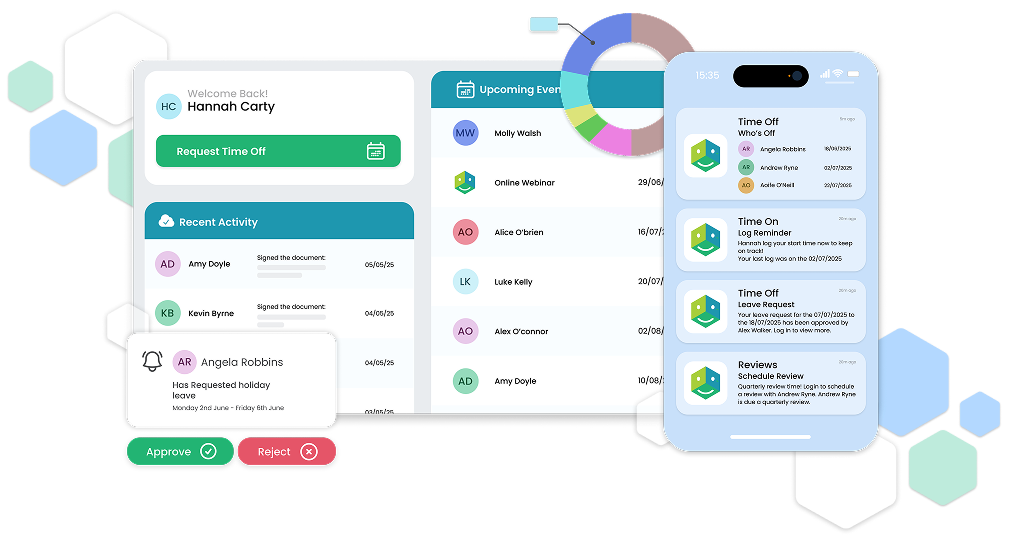
HRLocker helps Irish employers put the right structures in place long before the Directive takes effect, without the complexity or cost of enterprise HR systems.
With HRLocker, employers can:
- Capture objectives, ratings, and commentary in one place
- Standardise hiring workflows and templates
- Keep pay structures and role evaluations accessible
- Reduce admin and compliance risk through audit trails and reminders
- Document performance consistently
- Link performance to pay decisions more easily
- Store everything in one secure place
- Respond confidently to employee requests
- Reduce compliance risk
With HRLocker you can turn the Directive’s requirements into everyday practice rather than a last‑minute scramble.
Need More Help?
Check out our dedicated Pay Transparency resources.
Guides and whitepapers
- The Irish SME Quick Guide To The EU Pay Transparency Directive
- How To Hire Fairly and Compliantly Under the Pay Transparency Directive
- How To Build Your Pay Structure: A Step-By-Step Guide For Irish Employers
- Why Performance Management Is The Foundation of Pay Transparency
- How To Run A Joint Pay Assessment Procedure
Webinars
Checklists
- Pay Structure Self-Audit - use this to assess how pay-transparency-ready your organisation is and pinpoint exactly where attention is needed.
- Performance Management Audit Checklist - use this self-assessment to gauge how ready your organisation’s performance management framework is.
- 30‑Day Implementation Roadmap - a three-week action plan to build a compliant performance and pay framework.
Policy Templates
- Pay Structure & Pay Equity Policy Template - a ready-to-use, customisable framework for Irish employers, covering job levels, pay bands, progression, and equal pay compliance.
- Anti-Retaliation Clause Template - an addendum to the Pay Structure & Pay Equity Policy Template required under Article 13 of the Pay Transparency Directive.
Toolkit
- Salary Transparency In Job Ads - three before-and-after job ad examples showing how to replace vague salary language with transparent pay ranges.
- Fair Hiring, Scoring and Decision-Making Playbook - at‑a‑glance rules for consistent and defensible hiring.
- Pay Conversation Scripts - how to respond when employees ask the hard questions.
- Pay Structure & Pay Decisions Manager Cheat Sheet - a customisable template to give managers the information they need at a glance.
Frequently Asked Questions
When will the Directive be implemented in Ireland?
Ireland must transpose the Directive into law by 7 June 2026, but it is unlikely the full legislation will be ready by that date. Once the Irish law takes effect, employers will be expected to comply immediately, even if the national rollout is phased.
Does this apply to small businesses?
Yes. Most requirements apply to all employers, regardless of size. This includes salary ranges in job ads, objective pay criteria, and responding to employee information requests. Only the annual gender pay gap reporting threshold is size‑specific (50+ employees).
What happens if we can’t produce documentation?
If an employee challenges a pay decision and you cannot provide evidence, such as objectives, ratings, commentary, or role‑evaluation records, the burden of proof shifts to you. Without documentation, you may be exposed to findings of unequal pay, back pay, and compensation.
Do we need new HR software?
You don’t need enterprise‑level systems, but you do need a way to store performance reviews, pay criteria, hiring documentation, and role‑evaluation records in one place. HRLocker is designed to help SMEs meet these requirements without unnecessary complexity.
What counts as “objective criteria”?
Objective criteria are clear, measurable, gender‑neutral factors used to determine pay. Examples include skills, experience, qualifications, performance outcomes, responsibilities, and working conditions. These criteria must be documented and applied consistently.
How far back does our evidence need to go?
The Directive is effectively retrospective. Any pay decision challenged after June 2026 may require evidence from earlier performance cycles. Employers should ensure documentation from 2025 onwards is complete, consistent, and stored securely.