Author: Dee

3 min read

Time Management Software Helps Your Team Focus on Shared Goals

Even if you’re not billing out project hours or measuring how resources are employed across the organisation, time management tools will give you the real facts about how time is split across each section of the team.

Individuals will also appreciate how their days are spent and can optimise their working habits to ensure they’re using time effectively. Rolling out timesheets won’t always be the most popular decision, but logging hours really does have benefits in the end.

Time management software systems are not just about clocking in and out. Although we use timesheets to log total hours in-house here (this is a legal requirement in Ireland), we also use ‘Projects‘ to record hours worked on specific jobs.

It's not unusual in many modern, fast-growing companies with flat structures that hours are split across both sales and marketing tasks and sub-tasks. Keeping a note of these – and associating hourly costs to them – helps to keep track of time spent in these roles and associate them with cost centres after the reports are exported each month.

picture of egg time for blog post about time management software

Recording Hours Doesn’t Just Benefit Managers and Employers

Accurate records are also helpful evidence for staff to illustrate when they have pressures on time spent focusing on specific functions and to prove why they might need the additional resources they’ve been requesting.

Similarly, managers can also give meaningful guidance on where to adjust or correct the ratios of time spent. Or assistance in helping to streamline the workflows of team members to correct the proportions of where focus and priorities should lie.

This horizontal and vertical approach to logging working time provides managers of remote, hybrid, and flexible workers with a strong overview of what their team is doing.

Time management solutions integrated into the wider HR management suite give a further, holistic view of where resources are employed.

A single solution that can export data on all billable hours, total worked hours, and employee costs makes sense for reporting, resource planning, and accounting purposes. 

Solutions that allow you to log in from any device, anywhere, add a further element of control, especially for remote teams in the field.

Clocking in and out from the road using a mobile and adding notes on which client or project the team member has interacted with or spent time preparing material or following up on – is invaluable for billing purposes.

One of the main things that rose to the surface when we started using the project hours in-house here was how working in blocks is way more efficient than flitting from task to task.

Even some of the more experienced team members, especially, have shifted from being vehemently proud of their multi-tasking abilities from days of yore to realising that reacquainting yourself with projects that you dip in and out of is super inefficient. Whereas allocating time and working to make progress on larger chunks of work is much more effective.

And all this is only apparent once time management software is in place to show the facts.

If you don’t record the facts – and base actions on that data – then aren’t you just guessing?

Time Management Software – Everything You Need To Know was last modified: August 20th, 2025 by Agile Communications
(more…)

1 min read

Since the beginning of the pandemic, the effect Covid- 19 has caused changes to the working world that employers or employees couldn’t have foreseen three months prior.

(more…)

5 min read

In an era where compliance, data security, and employee experience matter more than ever, organisations must evolve or risk falling behind. This is the story of a mid-sized technology company that, faced with legal pressure and operational gaps, embraced transformation. Their journey from informal practices to a structured, compliant, and tech-enabled HR function offers a compelling lesson in the power of strategic investment and expert support.

The Challenge: Legacy Habits Meet Modern Expectations

Despite being well-established, with around 200 employees, the organisation had never implemented a formal HR department. For years, it operated on trust, tradition, and fragmented processes. There was no single source of truth for employee data, and HR responsibilities were scattered across teams without structure or accountability.

That status quo was shattered when the company was issued a judicial directive: establish clear HR policies, ensure legal compliance, and build a reliable, professional HR infrastructure. It wasn’t just a wake-up call—it was an existential challenge!

The risks were real:

  • Manual record-keeping led to errors and inconsistent employee data.
  • Managers had no formal HR training or policy framework to support decision-making.
  • Compliance with employment legislation was patchy and reactive, not proactive.

The leadership team recognised that patchwork fixes wouldn’t cut it, deciding it was time for a systemic change.

The Turning Point: Embracing a Human Resources Information System (HRIS)

Rather than build HR infrastructure piece by piece, the company took a bold step: implement a robust, centralised HRIS. This wasn’t just about introducing new software. It was about overhauling how the business understood and delivered its people function.

Crucially, they brought in external HR consultancy support to manage the implementation. This proved essential. The internal team lacked both the bandwidth and the expertise to lead such a significant change while managing day-to-day operations.

The project unfolded in deliberate, structured phases:

1. Laying the groundwork

The initial focus was on auditing current processes and collecting disparate data from various departments. Surprisingly, Excel emerged as an unlikely hero, a simple but powerful tool to clean, validate, and prepare employee records for migration. This phase revealed just how fragmented the current system had been.

2. System selection and customisation

A rigorous evaluation of HRIS platforms followed. The chosen system needed to meet the organisation’s specific needs: compliance, automation, data security, and scalability. The consultant worked closely with software vendors and internal stakeholders to tailor the system before launch.

3. Pilot, rollout, and review

The company ran a controlled pilot in one department, fine-tuned the system based on feedback, and then launched a phased rollout across all teams. Training was embedded at every stage, not just on how to use the software, but also on the broader HR policies it supported.

The Outcome: A Resilient, compliant, and empowered HR function. The transformation was nothing short of remarkable.

Key achievements included:

  • Accurate, accessible employee records – No more paper trails or missing files. All data is now centralised, secure, and GDPR-compliant.
  • Automation of core processes – Routine tasks like onboarding, absence management, and performance tracking were streamlined, freeing up time for strategic HR work.
  • Improved legal compliance – Policies are up-to-date, consistently applied, and transparent. Managers now have clear guidance for handling HR matters fairly and legally.
  • Empowered managers and employees – With access to self-service tools and real-time data, managers can make better-informed decisions, and employees can take more ownership of their information.

This wasn’t just a technological win. It was a cultural shift. The business moved from reactive fire-fighting to proactive planning — from isolated workarounds to an integrated, accountable system.

The Role of External HR Expertise

This success would not have been possible without specialist support. The external consultant brought not only deep technical knowledge but also a neutral, experienced perspective. They were able to challenge assumptions, manage resistance, and ensure best practices were followed, all while keeping the project on time and within budget.

For any organisation navigating similar challenges, this story is a clear reminder: you don’t have to do it alone, but you do have to do it properly.

Time to Rethink HR?

Too often, HR is seen as a back-office function, only visible when things go wrong. But done right, it becomes the backbone of your organisation—a driver of culture, compliance, and business success.

If your HR systems are outdated, if your managers are unclear on policy, or if compliance feels like a moving target, it’s time to ask: what’s the cost of staying the same?

The future of HR is strategic, data-driven, and human-centred. With the right tools and the right expertise, you can build a people function that does more than just keep the lights on. It powers your organisation forward.

Guest contributor

This article was written by Rabia Mirza, CEO of Leadership & HR Solutions, based in Dublin. She is an accredited HR Consultant, a top-rated Executive Coach and Trainer.

Rabia believes that by developing leadership skills and efficient HR procedures, organisations can help mitigate risk, enhance performance and improve an organisation’s EBITDA. Her services include Executive Coaching, People Management training and Outsourced HR Consulting.

Rabia has extensive knowledge of HR and leadership development across industrial manufacturing and logistics sectors. For more than 20 years, she has held senior roles in Human Resources, developing leadership teams, mitigating risk and creating efficiencies in businesses. Her experience extends from Ireland to Canada, and the USA, managing multiple sites globally.

Rabia has been rated as one of the Top Coaches in Ireland in 2025, 2024 and 2023. In addition, she is Chairwoman for Women in Logistics & Transport for Ireland. Her articles and webinars are regularly featured in business and industry magazines, organisations, and radio stations.

Transforming HR: How One Organisation Harnessed the Power of HRIS to Rebuild from the Ground Up was last modified: August 21st, 2025 by Agile Communications
(more…)

2 min read

Lone working comes with a range of risks, so it's important to identify and think through such issues. The nighttime shopkeeper, the care assistant, the machinery operators, the caregiver, the driver, the prison warden, the travelling corporate, the consultant, and so many more all work partially or fully alone.

Establish a Lone Working Policy

Companies must consider how to care for their lone workers and provide practical guidance on how to ensure the provision of a safe and healthy working environment for lone workers within the organisation. No matter what risk we are trying to mitigate against, we need to start the process through the completion of a risk assessment, which will ensure that we can write a policy that is specific and suitable to the conditions of our specific organisations’ lone workers.

All these documents then need to be examined and shared with your lone workers to double-check they are relevant and fit in with what they do. Here at HRLocker, all of our employees work remotely. They must have either a clean dedicated space to work in at home, or if that is not possible, we source a co-working space for them.

Here in Ireland, we have a housing crisis, so the lone worker is the future, with movements like Grow Remote putting the needs of lone workers in the public eye and the new national broadband scheme things are looking up for connecting our lone employees with their coworkers in new innovative ways.

If you are interested in being part of the HRLocker journey and the possibility of remote working, check out our careers page. We're always on the look out for more lone wolves to join our team!

Creating a Practical Lone Working Policy was last modified: July 29th, 2025 by Agile Communications


(more…)

5 min read

Employees in Ireland now have the right to request remote work. But do you have the resources, infrastructure, and technology to support it?

If you can’t answer that question just yet, it’s time to do the work. Employees must submit requests for remote work at least eight weeks in advance of the intended start date. But employers must respond to these requests within four weeks – which isn’t much time to prepare.

With that in mind, here are some things you should focus on ahead of remote working requests.

What’s Your Strategy?

Before you sign off on any remote work requests, it’s vital that you lay the groundwork. Having a specific remote work policy is crucial, especially when it comes to standardising your remote work approach.

Here are some of the elements you should include:

  • Eligibility criteria, as specified by the government, require employees to have at least six months of service.
  • Guidance on setting up a secure, safe, and healthy remote work environment. Check out the HRLocker Remote Working – Health and Safety Checklist to ensure everything runs smoothly.
  • Tools, equipment, and supplies. Consider what staff will need to do their jobs remotely, and assess what you can or can't supply to meet these needs.
  • Core working hours, attendance, and time-tracking specifications all need to be taken into consideration.
  • Preferred communication channels for you and your remote workers to keep in touch.
  • Remote work options include whether employees have to work from home, or if they can do so while travelling, or in coworking spaces.
  • Any legal requirements pay particular attention to any laws and regulations that need to be met.
  • Tax allowances for remote working and any other financial stipend you may choose to provide.

If you’re using HR software, add this policy to the employee portal so that individuals can return to it at a later date. Once you have a policy in place, be sure to update your employee handbook and safety statement.

Communicating the specifics of your remote work policy and approach is essential. Make sure you use all the platforms available to you, such as employee HR portals, internal emails, and team meetings, where you can field questions and respond to individual needs.

Where requests for remote work have been accepted, you should also consider updating or reissuing employment contracts. This is easier to manage if you have HR software in place that facilitates document sharing. You can make changes in the system and manage signatures and sign-off in one place. 

Do You Have the Right Tools and Tech in Place?

Remote work doesn’t work if you’re still dependent on pen and paper. Having the digital tools, processes, and infrastructure in place to support remote work is just as important as having a place to work.

Laptop with Home Office displaying on the screen
First of all, you’ll need a knowledge hub. This is a cloud-based location where employees can access resources and tools relating to their jobs, wherever they’re based. For many, this is as simple as using Microsoft 365 or Google Drive to store and share information.

You may also need to upgrade your communication channels. If you’ve relied on office osmosis in the past, that won’t do for remote workers. Establish clear channels for communication, and be sure to cover asynchronous (instant messaging or email) and synchronous (video calls or in-person meetups) methods.

Spend some time considering your security approach, too. It’s much easier to manage devices tied to a specific location, and implementing remote work might require you to invest in additional security software to protect individuals and the company. Be specific about where and how company devices can be used, and if employees are using personal devices for work purposes, make sure you offer guidance here too.

In your quest to support remote workers, don’t miss the obvious: giving employees access to the tech and tools they need to do their jobs. Set up accounts, log-ins, and profiles before your employees start remote working – so time isn’t wasted on chasing up access.

Are You Protecting Connections?

Remote workers aren’t antisocial!

There are countless reasons why people may choose remote work over office-based work. For some people, remote work is more accessible. It allows them to manage a chronic illness or disability, supports parents who need to balance work and childcare, and may be the preference for neurodivergent people who require specific environmental adjustments.

But that’s not to say you should stop socialising and connecting with teams in person. One option is to have a quarterly away day or social event where individuals can reaffirm bonds with their colleagues. Some remote-first companies set up ‘workation’ trips, where colleagues come together for socialising, strategising, and team-building activities.

Workplace Social Events Policy Template


These events don’t have to be grandiose. A team lunch and in-person coworking sessions every month can be enough to help colleagues connect. It takes time for individuals to adjust to remote working, so making sure there’s support in place and opportunities to strengthen social bonds is key.

Give serious thought to employee wellbeing, too. Remote working can be isolating if individuals don’t have systems and support in place. You could assign a remote work wellbeing ambassador to check in with individuals who’ve adopted remote work. Support with building daily schedules and managing workloads should also be provided since it can be difficult to establish if people are overworking when they’re not physically present.

Don’t be disheartened if remote work doesn’t work for your company immediately. It takes time and heaps of trust to make distributed teams effective. Keep checking in with your employees, and take inspiration from the companies adopting a remote-first approach successfully. If you want to secure the best talent and provide for your people’s unique needs, offering remote work can be a positive step towards that.

For more help with generating a remote work strategy, check out the government’s remote working checklist.

Right to Request Remote Working: Is Your Business Prepared? was last modified: August 7th, 2025 by Agile Communications
(more…)

5 min read

According to Gartner, only 9% of HR functions are highly efficient and highly aligned with organisational needs. As more and more work moves into the remote sphere, businesses need cloud-based HR structures and systems that can scale with them.

But timing is everything. Too much too fast, and companies struggle to see a return on investment. Too slow, and teams grow frustrated with a seemingly endless digital transformation project.

The pandemic pushed us into the virtual sphere at breakneck speed. And if we’re being honest, it did break a few businesses on the way. But it’s not a lockdown anymore. We can take a step back, evaluate, and move intelligently into the digital future.

We can approach digital HR solutions sustainably – with minimal disruption and maximum return on investment.

Why Introduce a Digital HR Solution Early

Modern HR platforms are designed to grow with your business. If you introduce a basic version early, you’ll already be familiar with using an HR platform when you need to scale it up.

Instead of rushing to fill gaps in your HR capabilities when things get busy, you can steadily increase automation and digital transformation. You skirt the disruption that comes with implementing new technology. And you get the luxury of time – more room to think strategically.

A process set-up at the beginning is much harder to dismantle further down the line. Digital HR lets you get those processes right the first time, ironing out inefficiencies before they appear.

Instead of being bogged down with repetitive tasks, your people get stimulating work – and more time to think about enhancing company culture, engaging employees, and attracting recruits.

When to Introduce a Digital HR Solution

The earlier you introduce a digital HR solution, the easier it will be to scale. Starting small with a few simple software implementations gives your people time to acclimatise to digital HR. If you’re struggling and don’t know where to start, there are supports like the Digitalisation Voucher from Enterprise Ireland.

These grants aim to facilitate strategic intervention for companies to work with third-party consultants to assess their digital maturity and highlight where there’s room for improvement. The output of this engagement is a strategic digital roadmap for your business.

Office setup

A digital HR solution doesn’t automatically mean an enterprise-level platform with a library of functionalities. It can be a software package that allows you to automate workflows like booking annual leave, recruitment communications, and basic onboarding tasks.

Start by automating the jobs that make your teams less productive. Things like searching for distributed information that could be in one centralised, secure database. Or booking holidays using manual approvals, when you could have an automated system to record and approve leave.

Research suggests that 78% of candidates drop out of overly long or complex recruitment processes. But digital HR platforms expedite the recruitment process immediately – with an integrated ATS, automated candidate messages, and simple calendar integrations for booking interviews.

The benefits aren’t just time and resource savings but also increased autonomy – something Harvard Business Review says modern employees are actively seeking. If you empower employees with a personal app, they can take control of recording their time. They can independently identify where they’re spending a lot of time, whether it’s too much time and correct. Employees get to manage their time instead of letting it manage them.

Three Tips for Introducing a Digital HR Solution Effectively

1. Start slow, start small

Introduce digital HR as early as possible and automate the really simple things first. Focus on what you can do to make the business more productive and your people more satisfied with their jobs.

Just as AI tools like ChatGPT can give people more room to think – by helping with structuring, consolidating, and presenting information – systemising gives teams more room to strategise and focus on creating impact for employees.

Digital HR removes the clunky workflows and inefficient structures that hold people back and gives them time to think and take action.

2. Pick something that fits your needs now and scales with you later

Buying a complicated enterprise HR solution in the early days is like buying a 20-bedroom house as a sole occupant. You pay for a host of functionalities you don’t use, which means it’s harder to return your initial investment. Remember: automate the basics first.

Ideally, you want to work with a platform with at least three years’ scope. Choose a system that can solve the immediate issues in your business and has the potential to solve the ones you foresee in six months, a year, and further down the line.

Man working from home

Modern HR platforms are responsive to their users – don’t think you can’t have your say on what you need from a platform.

In three years, just as your business will have evolved, your HR platform will have evolved too. Pick something with the potential to scale, and you won’t need to go through the rigmarole of integrating new software.

3. Automation first, analytics second

There’s more to digital HR than automation. Analytics and insights can help you protect and uplift your people. You might spot an employee putting in extra hours by keeping an eye on the trends, opening the door for critical conversations: Are they having trouble with their job? Are they unresourced? Do they need help? Do they need more training?

However, it takes time before analytics can add real value to your business. You need volume and time to spot patterns and trends. If you have a particularly small team, there aren’t enough data points to draw valuable conclusions.

Start with automation and progress to analytics. As the company grows, activity increases, and people join the team, you can do more with analytics. Bide your time.

Don’t buy a 20-bedroom house

Digital transformation in HR goes wrong when people try to do too much too fast, so focus on one or two challenges and start there.

When it comes to HR solutions, look for something that will scale with you (but won’t overwhelm your team). Remember– a 20-bedroom house requires a whole lot of care.

How and When to Introduce a Digital HR Solution was last modified: July 30th, 2025 by Agile Communications
(more…)

3 min read

When it comes to sustainability, one of the things that your business could look at is how much energy are you spending on a daily basis. Saving energy or using more sustainable energy alternatives will not only help the environment but as well allow your company to save money.


How to Make Your Business More Energy Sustainable

There are various quick measures that your organisation can implement to make your business more energy sustainable. You should follow these steps:

Analyse your Electrical Bill

Firstly, you should understand your electrical bill and get a sense of your usual weekly energy consumption. Just then you would be able to know how can your business become more energy sustainable.

Keep track of your Energy Consumption

Ensure that you keep track of and monitor the consumption of electricity in your business. Perhaps, it could be a good idea to appoint an employee to supervise your organisation’s energy usage.

One pair of hands holding a light bulb the other holding planet Earth

Establish an Energy Management Plan

Create an energy management plan and set energy efficiency targets for your business. As well, make sure to get your staff involved and make them aware of your energy savings goals.


Where Can Your Organisation Be Spending More Energy

When establishing an energy management plan, there are some key areas you should focus on. Some examples of those are:

Lighting

Lighting systems can be responsible for up to 40% of a building’s energy use. Evaluating your lighting energy use can help your organisation become more sustainable and save some money.

turning off light switch

You may…

  • Replace lights with energy-efficient alternatives such as LED bulbs, which use considerably less energy.
  • Install occupancy sensors to make sure lights are not left on unnecessarily.

Heating, ventilation and air conditioning

Did you know that by turning the heating up to 1°C, you increase your heating bill by approximately 8%? By turning down the temperature to only 1ºC you would already be saving money without really any discomfort.

You may…

  • Insulate the building.
  • Turn down the heat outside business hours and don’t waste heating on unoccupied areas.
  • Coordinate your air conditioning and heating to avoid wasting energy.

Transport

Do you really need to have everyone at that meeting? Could it be an online call? Have you considered the possibility of remote working? You should make sure that your employees are only commuting if necessary. If so, when commuting is required, just paying attention to how we drive can make a difference. An aggressive driving style can lead to an increase in fuel consumption of 10-12% above average.

toy car

You may…

  • Be aware of the way you drive by for example maintaining a steady speed and not over-revving the engine
  • Consider switching to electric vehicles. An electric car is significantly more energy efficient than a Diesel one.

Office equipment

Simple day-to-day behaviours can make a considerable difference in your organisation’s energy sustainability. Just by ensuring that your employees are energy aware, you will quickly see a big impact on your business energy consumption.

You may…

  • Switch on the eco option on all your devices. By doing this, for example, a photocopier can save up to 92% of its typical energy use.
  • Ensure to check the energy efficiency rating label when acquiring new equipment. Devices rated A are the way to go!


For more information on Sustainability in the Workplace, click here.

Help the Environment by Making Your Business Energy Sustainable was last modified: July 22nd, 2024 by Jenny Martin

(more…)

8 min read

Great news! Your organisation is expanding and you’re tasked with leading a recruitment drive. You’re wondering now how to hire and interview for the best outcome. Naturally, you want to do this as effectively as possible—you want to get it right.

Because if you don’t, it can be costly, time-consuming and disastrous for your business on so many levels.

Recruitment Process: How to Conduct an Interview and Hiring Steps
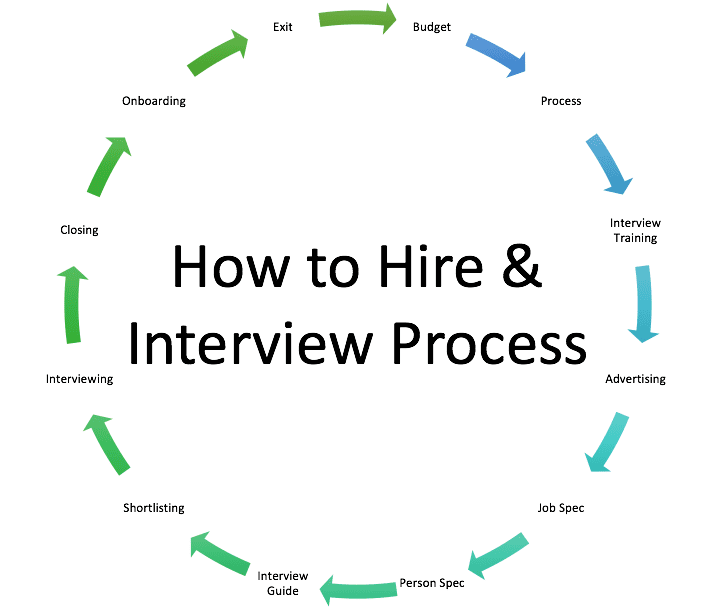
diagram showing how to hire and interview guide process

1. Define the recruitment budget and who owns it

It’s a simple question, but who owns the cost of hiring in your organisation? Have you looked at this and calculated the cost of your operations? Finding and hiring the right people is crucial to the success of every business and can be an expensive exercise, especially when you get it wrong and have to repeat the exercise. Someone needs to take responsibility for this budget and ensure it’s not an open line item slipping through control.

Also, consider the hidden costs and strain on efficiency and output placed on the rest of an organisation when others have to carry extra responsibilities in between hires and during probation and onboarding periods. In many organisations, this is a company-wide budget. But in our experience, many places overlook this, so the cost of hiring becomes expensive. It’s one area where there’s a lot of money to be saved, especially if the cost can be restricted to each manager.

You can also choose to incentivise this. For example, establishing the cost of the hire at 15% of the salary cost and putting all savings made against this into the departmental social budget. Failing to focus on hiring budgets means more money is wasted in organisations than you can imagine. The cost of using a recruiter alone is around 20% of the person’s starting salary. The cost of advertising can also be extortionate.

ATSs can cut your hiring and advertising costs by thousands. We explore this in more detail in our blog: What is an Applicant Tracking System – How Does it Work? 

2. Define the process, then follow it

Candidates and your team will want the process stages mapped out: “Plan the plan, then work the plan” is the ideal mantra. Stick to the plan, and everybody will know where they stand, the workflow will be fair, consistent and clear to all involved.

Your communications will need to state what the following stages of the process will be. For example, you may decide to conduct two screening calls per candidate to clear any primary issues to qualify them, followed by first and final interview rounds, then any relevant referencing, certification and medical checks. 

Ensure that you have a distinct flow and that the process is clear and easy to understand.

People waiting for interview

3. Interview training to ensure your staff know how to conduct interviews effectively

Hiring is not an intrinsic trait. It’s a learned skill. Use real data derived from your interview guide to judge candidates so that decisions are not made on instinct alone. If you or your managers aren’t trained in interviewing techniques, then invest in and facilitate training for them to develop this skill - this will pay dividends immediately.

The best hiring is done through behavioural interviewing related to company culture. Past behaviour is the way to predict future performance. Hiring on skills alone is inadequate.

You need agile people who are capable of learning, up-skilling and lateral movement. You need the people who say ‘No I don’t how to do that, but I’ll learn how to or find someone that can’.

If you’re worried about someone who ticks all the boxes but lacks the skills, then consider offering them the chance to train or study to get up to speed; the short delay is usually worth it in the long run.

4. Advertising the position

How do you get job specs in front of the right people? How do you best source valuable applicants’ CVs and attract the right kind of candidates?

Strong applicant tracking systems (ATS) integrate with major job boards as well as the company marketing mechanisms such as Twitter, Facebook and LinkedIn to get your advertised position in front of the right people.

You also need an automated referral program that not only yields good candidates but also gets the employees involved in building the company and cultural buy-in.

As an alternative, good recruiters can be worth their weight in gold in finding specialised candidates. But you’ll need time to identify these good recruiters. And it’ll take them some time to understand what best fits your organisation.

CV Hollogram

Not responding to CVs is a poor reflection on a company and can damage the company’s brand. When people send in their CVs, they’re exposing themselves in a vulnerable way, explaining their qualifications, their experiences and their ambitions. The least you can do is acknowledge this with a kind regret letter if you have no role for them. Again, the ATS automation will take care of this for you.

5. Produce a job specification

This should be linked to organisational values and produced with the incumbents' and the hiring manager’s involvement, to ensure it’s realistic. 

The spec should relate to the corporate behaviours and values you’ve established and communicated to your organisation. You need a successful candidate to buy into and perform to those values so that you can achieve your goals. Some organisations also involve their customers in the process if the person is, or will be, customer interfacing. 

6. Create a person specification

Ensure this is linked to key behaviours. And again, if it's for an existing role, involve whoever’s currently in this function and their direct manager. You can also get input from relevant customers, and other personnel will interact with the new hire.

Most important is to hire for the right behaviours you’ve identified as core to your company culture. The right characters will enhance output, remain assets, stay longer, be happier and contribute more to the overall effort. 

Focusing on skills or qualifications alone will only limit you, slow you down, and make you regret not reaching out for the livewires. You can teach skills, but it's a lot more challenging to alter someone’s behaviour.


7. Produce an interview guide

The principles of keeping to the job spec and person spec, related to company behaviours and values, will ensure you get to the right shortlist and eliminate candidates who will cost time and money.

To ensure equality and fairness, follow the same process and ensure all candidates get asked the same questions. Make sure you respond to all unsuccessful candidates. This is essential to maintain a good employer brand and actively demonstrate your corporate values and behaviours.

The direct report for the role must be the appointed hiring manager. They must be central to and kept in the loop at all stages of the process. Preferably, they will be the ones to make the final hiring decision.

Online Interview

8. Shortlist candidates

Tour ATS will help you shortlist your final candidates and compare notes and feedback with any colleagues involved with the process.

Screening and sorting interesting applicants by sticking to your plan by using the spec you distribute and communicate, is much easier with a good end-to-end recruitment management system.

What you want to avoid is strong candidates slipping through the cracks. An automated system will prevent this and pay for itself time and again, with costs saved from job boards and recruiters.

An ATS also automates communications about successful or unsuccessful applications and next steps.

9. Interviewing candidates

Behavioural interviewing techniques should be part of the induction programme for every manager who has been hired or promoted.

The most important aspect of the interview is collecting data. And then use it. Use it to match your desired job and person spec, behavioural profiles and values.

Ensuring you maximise the data you collect also means decisions are informed, not based just on gut feelings. Additionally, the data from interviewing informs future employee objectives, their continuous professional development (CPD), and performance management and appraisal  plans

10. Closing

Great news! You’ve followed the process and pinpointed your next superstar. Now it’s time to nail the deal. This is the negotiation and offer process encompassing compensation and benefits, working conditions, and the like.

Unless the market dynamics of supply and demand are against you, then the spec you produced and the process involved will have made it clear what you’re prepared to offer. Therefore, closing should be straightforward and within your budget, and the working conditions should align with those stated and advertised.

Whether you choose to deviate from this is up to you. Only you can decide if prima donna requests are within your defined acceptable behaviours and desired values.

11. Onboarding and induction

A smooth onboarding process allows your new hire to feel welcome and included so they settle in quickly. Be sure to use the interview notes as part of the induction, as the interview was effectively their first appraisal. 

These notes start a conversation to understand the strengths and development needs of your newest recruit, enabling you to set meaningful objectives going forward, taking their strengths and developmental needs into consideration.

Again, an ATS can help onboarding, seamlessly transferring successful candidates over to the main HR system so that they enter a new set of workflow automation for induction throughout their time in your organisation.

Happy girl working remotely

12. Exit or promotion and succession planning

Once an employment contract is ended, you’re obliged to keep records for a certain number of years to meet compliance. A good HR system will allow this. But you should always have good processes in place for succession planning, especially for strong leaders.

Similarly, for sideways or upward promotions, you need to end the flow related to this role and start it again for the next target, using the incumbent to optimise the job and person specs, and so on.

Whether you choose to formulate an exit process involving structured interviews is up to you. Whatever you choose, you should pin the process to the behaviours and cultural values from start to finish.

The Ultimate Guide on How to Hire and Interview was last modified: August 15th, 2025 by Agile Communications
(more…)

3 min read

Gender Pay Gap Reporting is an important initiative designed to measure the difference in average hourly wages earned by men and women. With reporting requirements becoming increasingly more common, employers need to be aware of the potential implications it could have on their organisation. Discover what Gender Pay Gap Reporting is, how and why it’s used, and how best to address it in your workplace.


What is Gender Pay Gap Reporting?

Gender Pay Gap Reporting is the process of measuring and reporting differences in average hourly wages earned by men and women. The pay gap is typically expressed as a percentage difference between the two. By collecting this data, organisations can assess their progress in ensuring gender equality in pay.

What Are the Requirements for Gender Pay Gap Reporting?

Gender Pay Gap Reporting is a requirement in many countries, including Ireland, the United Kingdom, Australia, and Germany. Organisations are required to report gender pay gap data that accurately reflects their workforce and compliance with laws on equal pay for work of equal value. Companies must also provide detailed explanations regarding any gaps in pay found between male and female employees.

How Can Organisations Address Gender Pay Gaps?

Organisations can analyse their workforce’s gender pay gap data and use it to address any disparities. It is important for companies to set goals and create strategies for how they will close the gap and reach pay equality between genders. This includes conducting an Equal Pay Audit to identify where potential differences in wages may exist, calculating salaries fairly according to job type and value, and proactively monitoring employer trends in terms of gender representation across job roles.

Companies should ensure they are providing full transparency regarding pay practices by educating all employees on the results from Gender Pay Gap Reports.

HRLocker has compiled a Gender Pay Gap Reporting Review. This report provides insights into the attitudes and measures being adopted by HR professionals in relation to the new reporting requirements, highlighting best practice approaches to GPG compliance.

Gender Pay Gap Reporting Review


What Benefits Come From Complying With Gender Pay Gap Reporting?

Complying with Gender Pay Gap Reporting has several advantages. By understanding and addressing any potential disparities, organisations are reducing the risk of facing a costly pay equity lawsuit from employees or job applicants who feel they were discriminated against in terms of wages and compensation.

Additionally, making sure all employees receive fair pay strengthens internal morale and promotes an atmosphere of trust between employers and staff, which can lead to improved employee satisfaction.

Finally, organisations that comply with Gender Pay Gap Reporting promote their commitment to equality and demonstrate a corporate-wide dedication to ensuring fair practice in the workplace.

What Are the Potential Consequences of Not Addressing Wage Disparities?

Organisations that don’t address wage discrepancies through Gender Pay Gap Reporting may face several potential consequences. If a discrimination lawsuit is brought against the organisation, it could lead to significant financial losses due to fines, legal costs, and potential reputational damage. Not addressing wage disparities can create long-term issues for organisations in terms of employee morale and job applicant attraction.

If potential job applicants believe the organisation does not prioritise fair pay for all employees, they may be less likely to apply for or accept an offer from the company.

What is Gender Pay Gap Reporting? was last modified: July 22nd, 2024 by Jenny Martin

(more…)

1 min read

Managing employee payroll can be a complex task, especially when you have a dispersed workforce with varying work patterns and compensation structures. This is where HRLocker’s Payroll Management Reports come to the rescue. These reports provide a seamless solution for tracking employee hours and payments, ensuring your payroll process is accurate, efficient, and tailored to your specific needs.

(more…)